
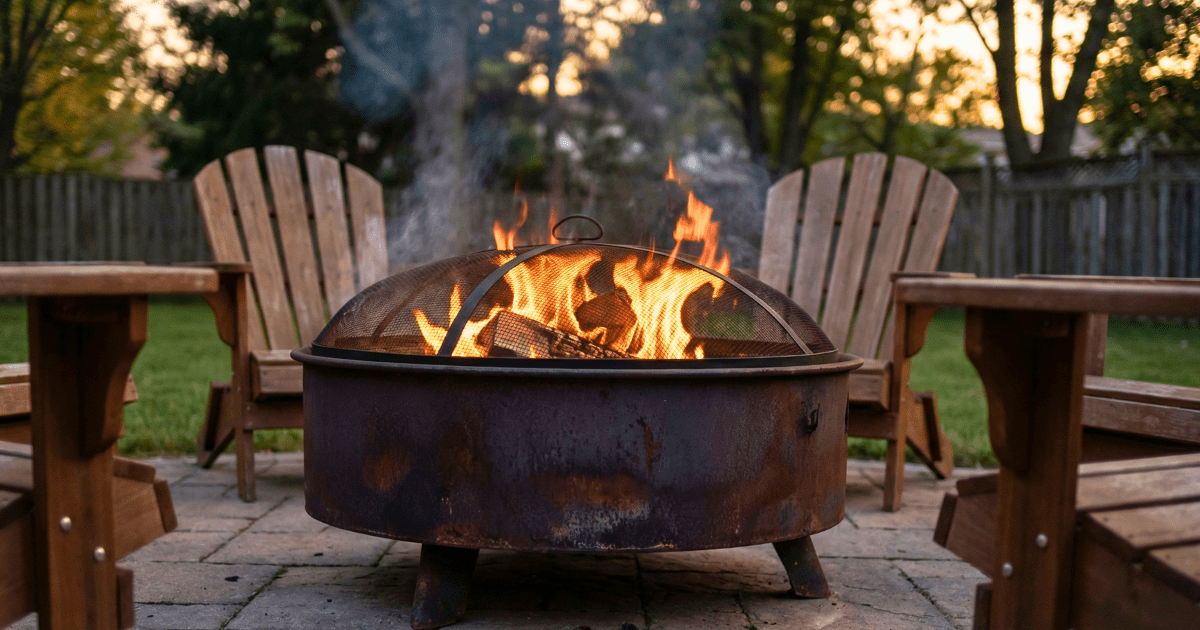
There’s nothing quite like gathering around a crackling fire in your own backyard. But before you light the first match, the fire pit itself needs to be built right. Here’s what to look for before you buy.
Most fire pit guides focus on how to use a fire pit safely — keep it 10 feet from the house, don’t burn on windy days, and so on. That’s all good advice. But it skips something important: the built-in safety features you should demand from the fire pit itself before it ever arrives at your door.
Whether you’re shopping for a wood-burning bowl, a smokeless fire pit, or a gas fire table, this guide breaks down the essential fire pit safety features — and why each one matters. For a broader look at choosing the right pit overall, check out our complete fire pit buyer’s guide.
The Consumer Product Safety Commission (CPSC) estimates around 6,200 fire pit and outdoor heater injuries are treated in emergency rooms each year. Pediatric burn research shows hands and lower extremities are the most commonly injured areas, with hot ash and coals as the leading causes.
The CPSC has also issued a severe consumer alert against fire pits that burn pooled isopropyl alcohol or ethanol. These units are prone to “flame jetting” — sudden, uncontrolled bursts of flame — and have been linked to two deaths and at least 60 injuries since 2019. Avoid them entirely.
The right fire pit, with the right features, cuts that risk significantly.
Wood-Burning vs. Gas: Different Fuels, Different Hazards
Before diving into specific features, it helps to understand how these two fuel types differ in their risk profiles. They’re fundamentally different problems that require fundamentally different engineering solutions.
Wood-burning fire pits deal with physical hazards — flying embers, extreme heat, hot ash, and smoke. Their safety features are mechanical and material-based. The goal is to contain what comes out of the fire.
Gas fire pits deal with fuel-flow hazards — undetected leaks, uncontrolled fuel release, and invisible flame-outs that let raw gas accumulate. Their safety features are technological and valve-driven. The goal is to control what goes into the fire.
Both need stable construction, heat-resistant materials, and proper clearances. But the engineering priorities are completely different.
| Safety Category | Wood-Burning | Gas |
|---|---|---|
| Primary hazard | Embers, ash, heat | Gas leaks, flame-outs |
| Feature type | Mechanical, material-based | Sensor and valve-based |
| Certification to look for | Heavy-gauge steel specs | CSA / UL certification |
| Key safety accessories | Spark screen, snuffer lid | Thermocouple, wind guard |
| Deck placement concern | Ember and radiant heat | Gas accumulation if enclosed |
Wood-Burning Fire Pit Safety Features
Wood-burning pits offer that traditional, crackly campfire experience. But they require specific physical features to keep embers contained and heat managed.
Heavy-Gauge Steel Construction
The thickness of the metal is a primary safety feature — and it’s one most buyers overlook. Thin steel (14- or 16-gauge) weakens fast under repeated heating and cooling cycles. Over time, it warps, thins out, and can eventually burn through — dropping hot coals onto whatever’s below.
For safety and longevity, look for carbon steel at 3/16 inch or 1/4 inch thick. Thicker steel distributes heat more evenly across the bowl and resists the structural failure that cheaper pits are prone to.
Spark Screens and Guards
A well-fitted metal mesh spark screen is arguably the single most important safety accessory for any wood-burning fire pit. Wood pops and crackles as moisture and sap heat up — and those pops send burning embers into the air.
A spark screen contains those embers before they can land on dry grass, a wooden deck, or a guest’s arm. It’s simple, inexpensive, and non-negotiable.
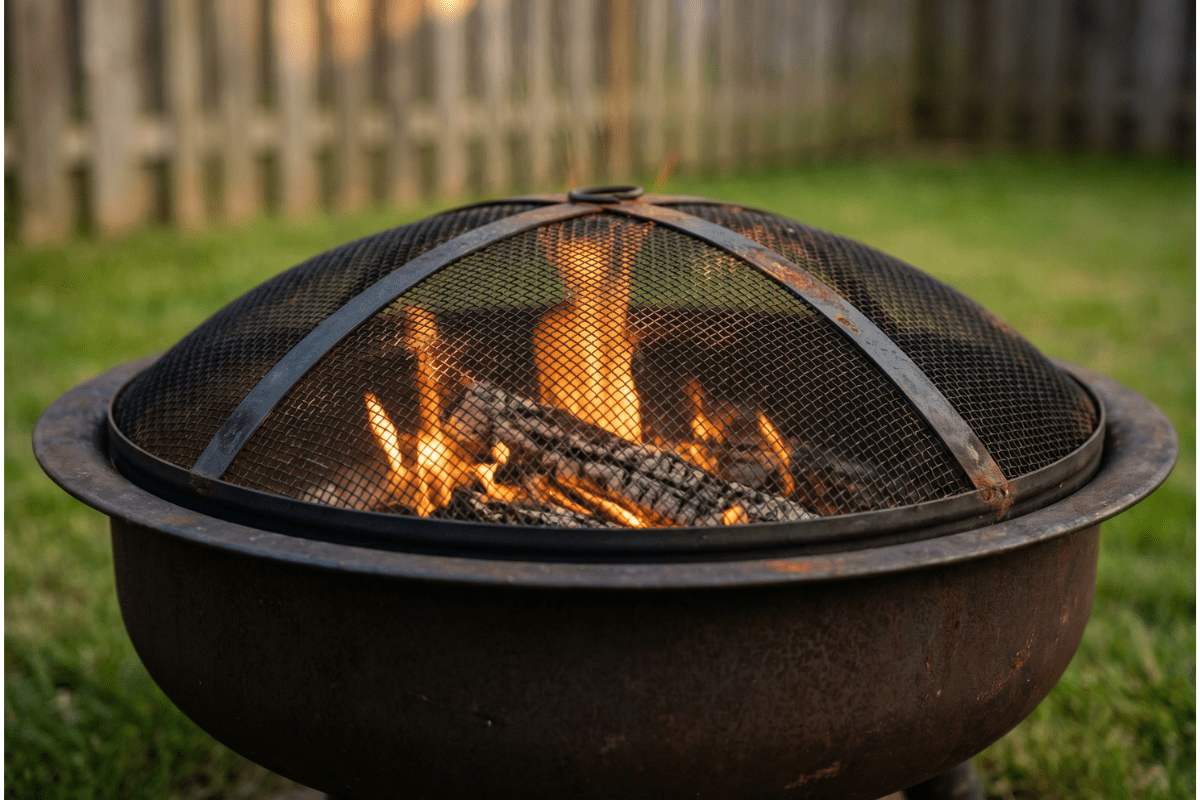 A tight-fitting spark screen is one of the most important safety accessories for any wood-burning fire pit.
Ash Management Systems
Hot coals can stay dangerous for days after a fire burns out. Fire pits with built-in ash catchers or removable ash pans prevent hot debris from falling through the bottom onto whatever’s underneath.
This matters most on wood decks and patios, where a stray ember landing in a gap or crack is a real fire risk. An ash management system also makes cleanup significantly safer — you’re not digging around in what looks like cold ash but might not be. If you’re planning a deck installation, read our guide to using a fire pit on a wood deck safely before you set anything up.
Smokeless Technology (Secondary Combustion)
Modern smokeless fire pits use a double-wall construction to pull air through the bottom and reinject it — preheated — at the top of the firebox. This creates a secondary combustion that burns off smoke particles before they escape.
From a safety standpoint, this dramatically cuts smoke inhalation risk. It also keeps your guests comfortable and your eyes from burning. Solo Stove and Breeo have popularized this design, and it genuinely works.
Snuffer Lids
A solid metal snuffer lid lets you safely extinguish a fire by cutting off its oxygen supply. This is far safer than the alternative — dousing the fire with water.
Pouring water on a hot fire pit causes dangerous steam burns and thermal shock. Repeated water dousing can also warp or crack the metal over time. If your fire pit came with a snuffer lid, use it.
Gas Fire Pit Safety Features
Gas fire pits — whether propane or natural gas — bring a different set of risks. Their safety features are more technology-dependent, focused on controlling what fuel enters the system and detecting when something goes wrong.
CSA and UL Certification
This is the baseline requirement. The primary North American standard for gas fire pits is CSA 2.17/ANSI Z21.97. A CSA or UL certification label means the burner system, valves, and components have been independently tested for leaks, combustion efficiency, and performance under adverse conditions.
Never purchase an uncertified gas fire pit. Full stop.
Thermocouple and Flame-Sensing Technology
A thermocouple is a temperature sensor that detects whether a flame is present. If the flame gets blown out by wind or extinguished by rain, the thermocouple senses the temperature drop and automatically shuts off the gas valve.
This prevents the most dangerous scenario in gas fire pits: an invisible accumulation of uncombusted gas. If gas builds up and then a spark is introduced — from a lighter, a phone, anything — the result can be an explosion. A thermocouple prevents that scenario.
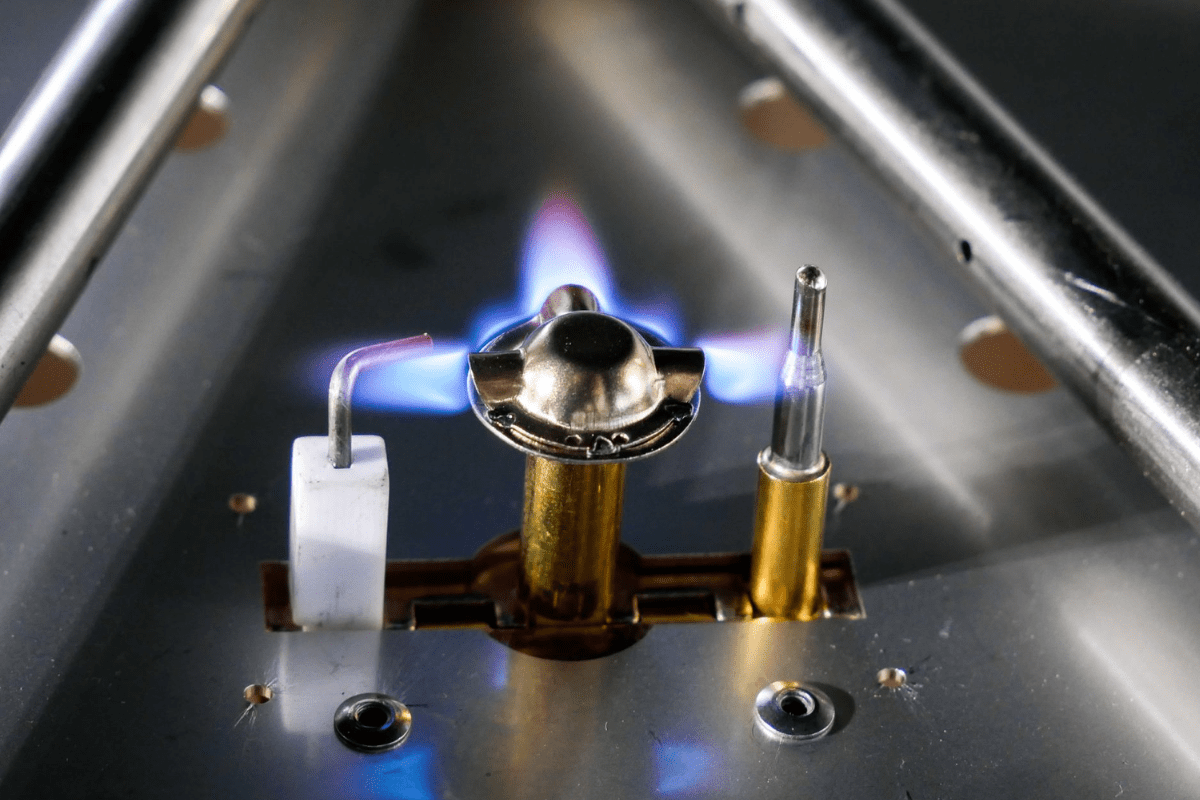 The thermocouple valve automatically shuts off gas flow if the flame goes out — preventing dangerous gas buildup.
Electronic Ignition Systems
Match-lit gas fire pits are common and generally fine when used correctly. But electronic ignition systems add a meaningful safety layer. They provide automatic lighting and are typically integrated with flame-sensing technology and emergency shutdown capabilities.
More importantly, they keep your hands away from the burner during ignition — which is when most gas fire pit accidents occur.
Wind Guards
Tempered glass wind guards do two things. First, they protect the flame from gusts, preventing erratic flame behavior that could catch guests or loose clothing off guard. Second, they act as a physical barrier between the flames and anyone sitting nearby — especially children and pets.
Wind guards are particularly important for gas fire tables with open flame designs, where the flame is lower and more accessible.
Automatic Gas Timers
Automatic gas timers are an underrated safety upgrade. These valves shut off the gas supply after a set period — typically one to three hours. If you forget to turn off the fire pit before heading inside, the system handles it for you.
This is especially useful for built-in natural gas setups, where there’s no tank to visually confirm is closed.
Proper Ventilation Design
Propane is heavier than air. When a leak occurs, propane sinks and pools in low areas. Any gas fire pit with an enclosed base housing the propane tank must have built-in ventilation panels near the bottom of the enclosure.
These panels allow leaked gas to safely dissipate rather than accumulate. If you’re shopping a fire table with a hidden tank compartment and you don’t see ventilation, walk away.
Safety Features That Apply to All Fire Pits
Regardless of fuel type, a few universal principles separate a well-engineered fire pit from a hazardous one.
A tipped fire pit is a serious emergency. Wide, stable bases or sturdy legs are non-negotiable — especially on uneven ground or around kids and pets.
Materials rated for extreme heat prevent structural failures. GFRC (Glass Fiber Reinforced Concrete) is excellent for fire table surrounds — it’s non-combustible and doesn’t transfer heat easily.
Placing a fire pit on a wood or composite deck without a heat shield is risky. These accessories reflect radiant heat upward, protecting the surface below.
The NFPA and U.S. Fire Administration recommend keeping fire pits a minimum of 10 to 25 feet from structures, overhangs, and combustible materials. See our fire pit placement guide for specifics.
Quick Buyer’s Checklist: Fire Pit Safety Features
Use this when evaluating any fire pit before purchase:
- Wood burners: Steel thickness of at least 3/16 inch
- Tight-fitting spark screen included or available
- Ash catcher or removable ash pan
- Snuffer lid for safe extinguishment
- Gas models: CSA or UL certification label
- Thermocouple or ODS (oxygen depletion sensor)
- Enclosed tank compartment has ventilation near the bottom
- All fire pits: Stable base, no wobble
- Compatible with a heat shield if used on a deck
- Safe for your intended clearance distances
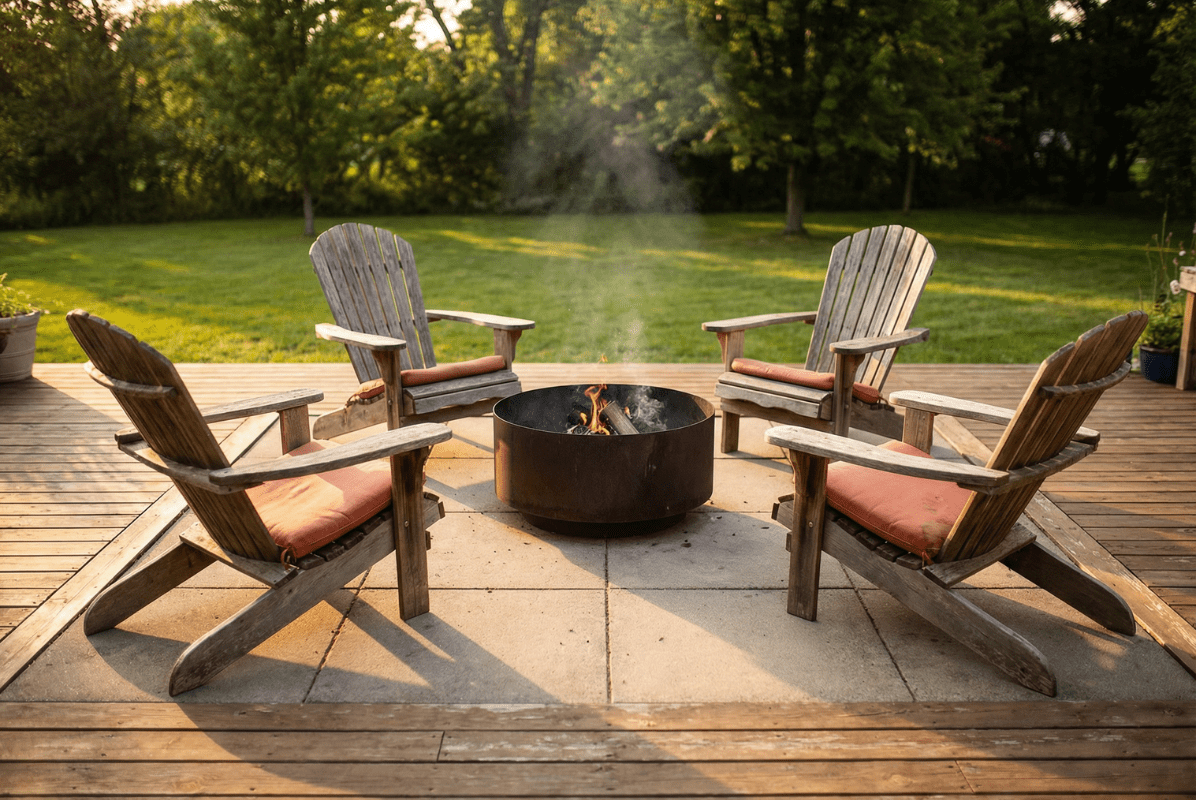 Proper spacing from structures and a stable paver base are two of the most overlooked fire pit safety fundamentals.
Don’t let aesthetics drive your fire pit purchase. A beautiful fire pit that skips key safety features isn’t worth the risk.
For wood-burning models, prioritize heavy-gauge steel, a quality spark screen, and a solid ash management system. For gas models, CSA certification and thermocouple flame-sensing are the absolute baseline — everything else is a bonus.
Get those right, and you’ll be enjoying backyard fires safely for years.
These are the safety accessories discussed above — available on Amazon. Your fire pit setup is only as safe as what you pair it with.
- Northland Defender Steel Ember Mat — Round Best Protection
- Northland Defender Steel Ember Mat — Square Best Protection
- Fireside Outdoor Fire Mat — Fabric Option Fabric
- Rumlick Bonfire Fireproof Portable Fire Pit Mat Budget Pick
- Higley Conical Snuffer Lid with Spark Screen Small Business
- Higley Flat Cover Spark Screen Small Business
- Fire Pit Snuffer Lid — Affordable Option Budget Pick
Not Sure Which Fire Pit Is Right for You?
Read Our Complete Fire Pit Buyer’s Guide →- Consumer Product Safety Commission (CPSC). Consumer Product Safety Data — Outdoor Heaters and Fire Pits.
- Fazal, M. et al. “Characteristics and trends of pediatric firepit burns.” World Journal of Pediatric Surgery, 2024.
- U.S. Consumer Product Safety Commission. “Stop Using Alcohol or Other Liquid-Burning Fire Pits.” December 19, 2024.
- S&S Fire Pits. “Fire Pit Care — Steel Thickness and Maintenance.”
- Consumer Reports. “Safety Rules: CR’s Guide to Fire Pits.”
- U.S. Fire Administration (FEMA). Outdoor Fire Safety.
- National Fire Protection Association (NFPA). Wildfire Prevention Tips for Fire Pits and Outdoor Fires.
- HPC Fire. “CSA, UL, and Safety Standards for Fire Pits.”
- Outdoor GreatRooms. “Gas Fire Pit Safety: What is a Thermocouple & Why is it Important.”